
The first roast chicken I cooked to exactly 165°F came out safe and sad: dry, tight, overdone. I had overlooked what all great chefs plan for. Meat continues to cook after it leaves the heat. If you pull it at your target temperature, it goes right past it. The trick is to stop short and allow carryover to finish cooking.
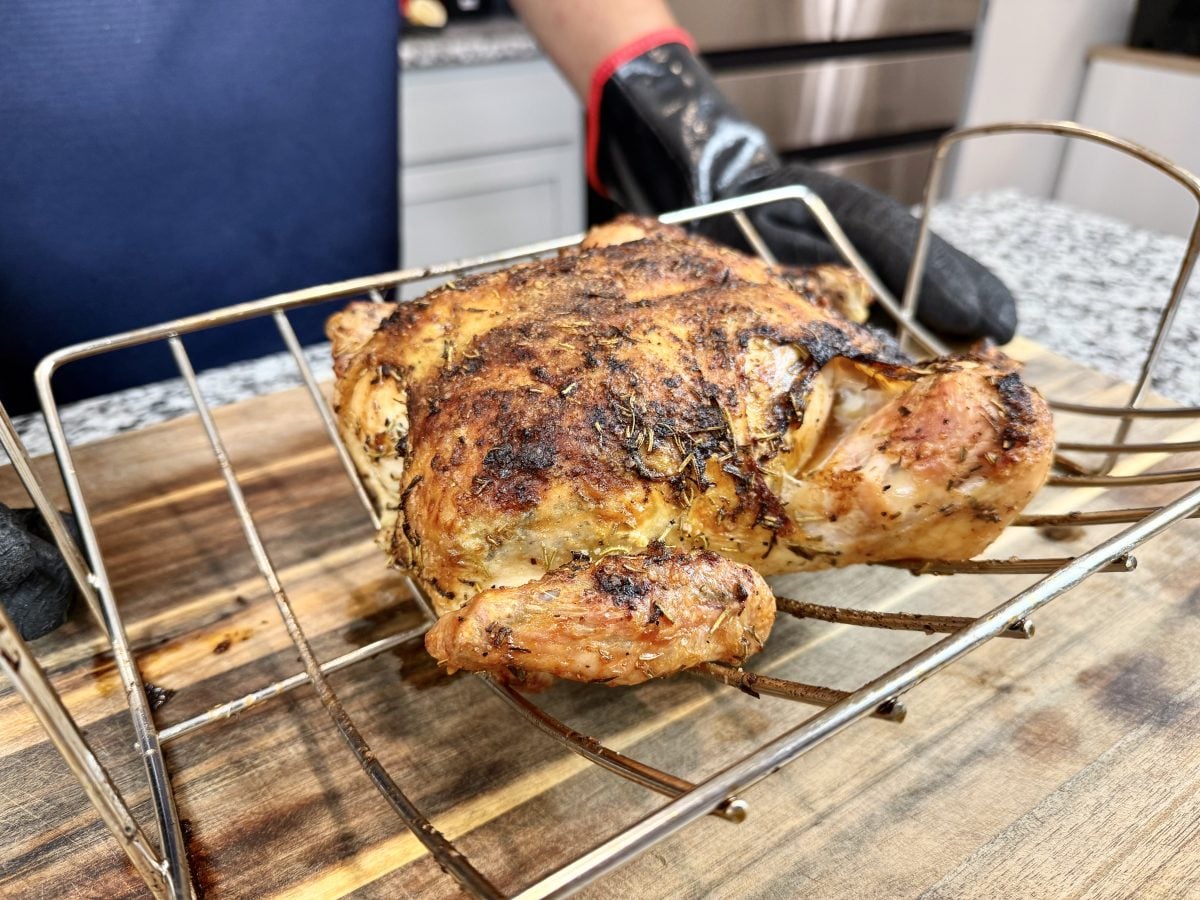
Here’s what happens. As meat cooks, heat moves in from the outside towards the center, faster on the outside than the inside. When you remove the meat from the heat source, the heat that has built up on the outside will continue to move inward, thus the temperature in the center will continue to increase, and the center will heat up.
Even though the oven isn’t on anymore, In the video, a piece of chicken pulled from the oven at 150°F internal drifts up to about 160°F on the counter. That’s roughly 10 degrees of free cooking.
The bigger the meat, the more carryover you’re going to have.
Nathaniel, HomeViable
| Cut | Expect carryover of | So pull it around |
|---|---|---|
| Steak or chops | 3 to 5°F | 5°F below your target |
| Whole chicken | about 10°F | 10°F below your target |
| Large roast or turkey | 15 to 20°F or more | 15 to 20°F below your target |
Make carryover work for you
- Pull meat below your target and let it rise. Leaving space above allows it to prevent overshooting into empty space.
- Bigger cuts carry over more, so plan for 10 to 20°F on roasts and rest them longer.
- Use a reliable instant-read thermometer. The carryover effect only works if you understand the internal temperature.
- When unsure, 165°F is the foolproof target for poultry.

The part about chicken and 165°F
This is where carryover gets even more fascinating. Chicken does not have to hit 165°F to be safe. Safety is a combination of both temperature and time. 165°F is just the temperature that destroys dangerous bacteria nearly instantly. If you hold meat at a lower temperature long enough to achieve the same level of safety, USDA’s own time and temperature guidelines show that poultry held at approximately 150°F for four minutes is just as safe as a quick 165°F.
A bird that has been in the oven for an hour and has been brought up to 160°F is still over that limit and is much juicier than one that is brought further to 165°F and beyond.
Pasteurization is a combination of both heat and time.
Nathaniel, HomeViable
The honest caveat: this only works if you actually measure it. Use a good thermometer, know your real internal temperature, and if you are ever unsure, cooking to 165°F is the simplest safe call. Anything past that just dries the meat out without making it safer.
Think of the number on your thermometer as a finish line that you want to coast across, not slam into. If you pull the meat early, let the heat redistribute, and you’ll achieve a juicier result every time, whether it’s a steak that needed to be pulled at 5 degrees, or a roast that needed to be pulled at 20.
